There's a management cliché that happens to be true: you can't manage what you can't measure.
For decades that logic stopped at the door of the inner life. We measured engagement, productivity, attrition and absenteeism – the downstream effects – while the thing driving all of them stayed invisible: the story each person is telling themselves about who they are, what they're capable of, and whether the future includes them.
That story is measurable. We call the measure the Narrative Health Score (NHS), and it sits at the heart of how we track progress in our Leading Well program, powered by our AI coaching companion, HUMAINWARE.
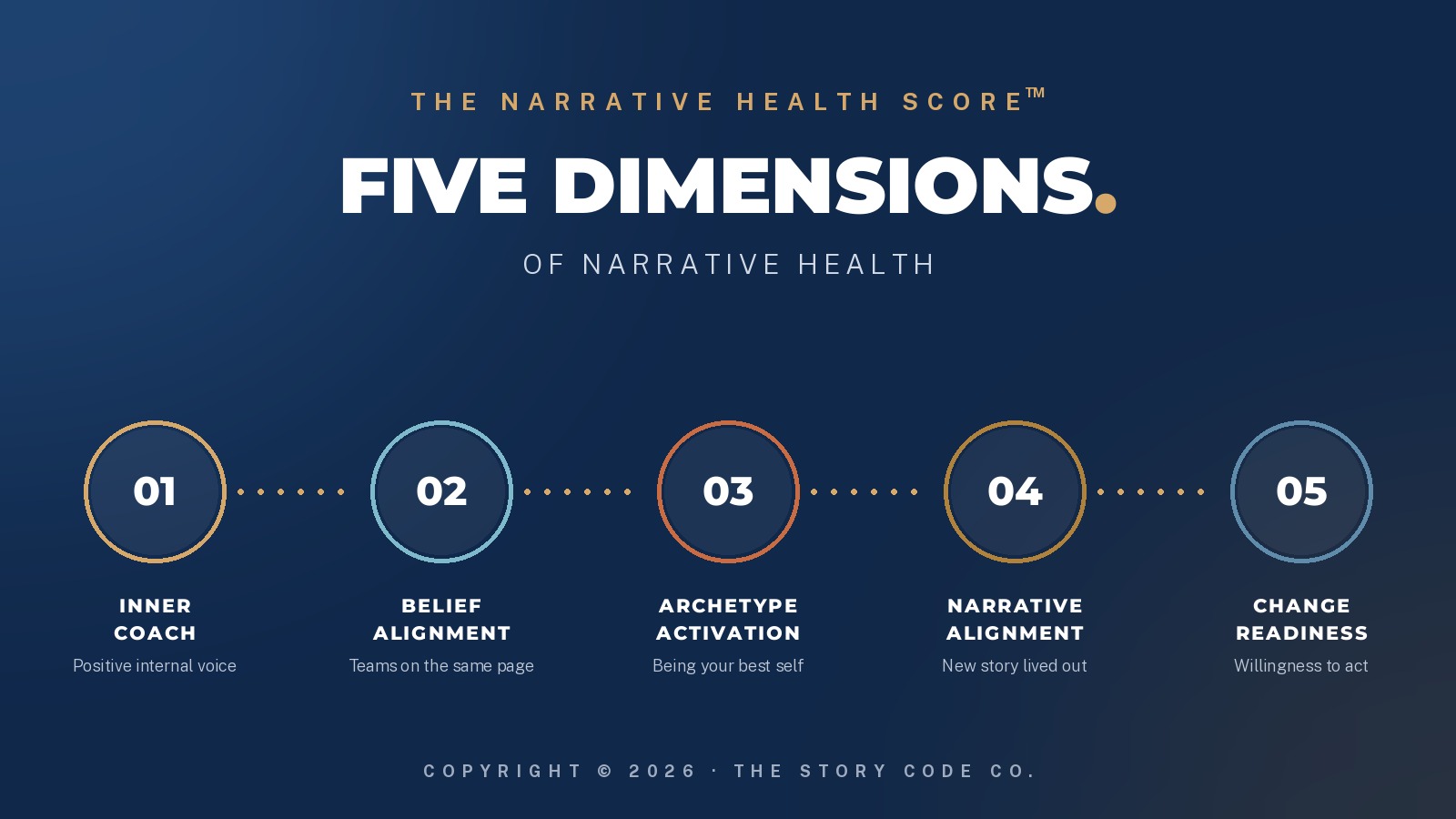
First it was IQ. Then EQ. Now it's NQ – Narrative Intelligence, the capacity to read, understand and rewrite the narratives running underneath your leadership. The NHS is how we make NQ visible. It's a score out of 10, built from five dimensions. Here's what each one measures, and why it matters.
1. Inner Coach
What it measures: the quality of your internal voice.
Every leader runs a constant internal commentary. The question is whether that voice behaves like an inner critic – you're not ready, you got lucky, don't get found out – or an inner coach: honest about gaps, but oriented toward evidence and growth.
This isn't about positive thinking. A strong Inner Coach score reflects a voice that tells the truth, kindly. Leaders low on this dimension carry self-doubt into every meeting, decision and team interaction – and research tells us roughly 1 in 2 will experience burnout. The Inner Coach score is often the first dimension to move in a program, because it's the first story we teach leaders to catch and flip.
2. Belief Alignment
What it measures: whether your team is on the same page.
Individuals hold beliefs; teams hold shared ones. Belief Alignment measures the distance between the story leadership is telling and the story the team actually believes. Strategy decks say transformation; hallway conversations say this won't work. That gap – the Vision Reality Gap – is where change programs quietly die.
A high Belief Alignment score means the official narrative and the ground-level narrative are substantially the same story. A low one is an early-warning system: it tells you resistance is forming long before it shows up in delivery dates or attrition.
3. Archetype Activation
What it measures: whether you're operating as your best self.
In our work, every leader discovers their Codebreaker Archetype – the version of themselves that shows up when their story is healthy: decisive, generous, calm under load. Archetype Activation measures how often that version of you is actually in the room.
Most leaders can describe their best self easily. The harder question is what percentage of the working week that person is present – versus the stressed, reactive understudy who takes over when pressure rises. This dimension tracks the gap between identity and behaviour, which is where authenticity either becomes real or stays a poster on the wall.
Want to know your own starting point? Our free NQ diagnostic takes a few minutes – and it might be the most revealing score you see this year.
4. Narrative Alignment
What it measures: whether the new story is being lived out.
It's one thing to write a healthier story in a workshop. It's another to live it on a Tuesday afternoon when the quarter is going sideways. Narrative Alignment measures the consistency between the story a leader has committed to and their observable behaviour over time.
This is the dimension we weight most heavily – it carries 30% of the overall score – because it's the primary commercial metric. Narrative Alignment is the bridge between inner work and business outcomes: it links directly to engagement, productivity and how fast an organisation absorbs change. Gallup's 2026 research gives us the stakes: a 10% lift in connection to purpose delivers 8.1% lower turnover and 4.4% higher profitability. Stories that are lived, not laminated, are what produce those numbers.
5. Change Readiness
What it measures: willingness to act.
The final dimension is the most forward-looking. Change Readiness measures whether a leader's current narrative opens possibilities or closes them down – their genuine willingness to move toward something new rather than defend the familiar.
This matters enormously in the AI era. Leaders who actively champion change multiply adoption across their teams; leaders who privately fear it transmit that fear, whatever their slide decks say. Change Readiness tells you which one you're really dealing with.
How it works in practice
Each dimension is scored, banded – gold, green, amber, red – and tracked in real time through HUMAINWARE, before, during and between coaching sessions. Participants see their own trajectory. Program sponsors see the cohort's: who's climbing, who's stuck, where the collective story needs attention. Research-backed banding comes with recommended next steps, so a score is never just a number – it's a prompt for the next conversation.
The five dimensions together answer a question most organisations have never been able to ask with any precision: how healthy are the stories our leaders are telling themselves?
Because here's what the data keeps confirming: those stories aren't a soft variable. They drive every decision, every team interaction and every culture. Measure them, and you can change them.
The free NQ Assessment measures all five dimensions of your narrative health – 10 questions, under 5 minutes, instant personalised profile.
Take the free NQ Assessment →